
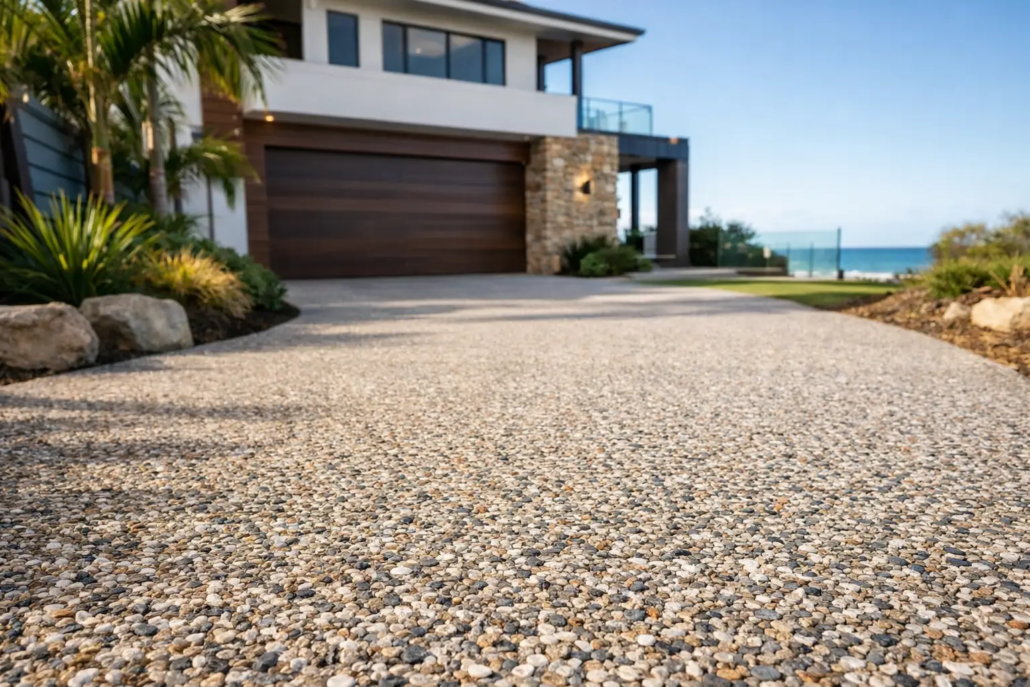
Gold Coast Exposed Aggregate Driveways
A driveway does more than get your car off the street. It frames the front of your property, handles daily traffic, and has to keep performing through heat, storms, tyre wear and constant use. That is why Gold Coast exposed aggregate driveways are such a common choice for homeowners who want a surface that looks sharp without becoming high maintenance.
Exposed aggregate has a very practical appeal. It gives you texture underfoot, a more decorative finish than plain grey concrete, and enough range in stone and colour blends to suit both modern builds and older homes. But like any concrete finish, the result depends on where it is used, how it is installed, and whether the mix and preparation match the site.
Why Gold Coast exposed aggregate driveways are so popular
On the Gold Coast, driveways need to do more than look good on handover day. They need to cope with strong sun, sudden downpours, sandy conditions in some suburbs, and the regular wear that comes from family vehicles, visitors and deliveries. Exposed aggregate suits those conditions because it combines the strength of concrete with a textured decorative surface.
The finish is created by washing back the top layer of cement paste to reveal the natural stone within the mix. That gives each driveway a more varied, premium look than standard concrete. It also helps with slip resistance, which matters on sloped driveways, around garages, and in areas that get wet during summer storms.
For many property owners, the draw is balance. You get a driveway that feels more considered architecturally, but still performs like a hard-wearing concrete surface. It is not trying to be flashy. It is simply a finish that works hard and presents well.
What makes exposed aggregate different from plain concrete
Plain concrete has its place. It is clean, functional and often suits minimalist homes. Exposed aggregate, though, gives you more visual depth. The stone creates natural variation, so the surface does not feel flat or overly industrial.
That extra texture is not only about appearance. It can improve traction compared with smoother finishes, which is a real benefit on driveways with a gradient or homes where people regularly walk across the area. If you have children, older family members, or a driveway that connects directly to a front path, that added grip becomes more than a design feature.
There is a trade-off, though. Exposed aggregate is more dependent on skilled installation. Timing during the wash-off stage matters. So does mix consistency, edge detailing, joint placement and the quality of the base underneath. If any of those elements are rushed, the finished surface can look uneven or perform below expectation.
Choosing the right look for your home
One of the main advantages of exposed aggregate is design flexibility. You can select aggregate blends that lean lighter, darker, warmer or more neutral, depending on the style of your home and the surrounding landscaping.
A contemporary home often suits a cooler stone blend with crisp borders and a clean layout. A coastal-style property may benefit from softer, sand-toned aggregates that sit comfortably with light render, timber features or subtropical planting. For older brick homes, a warmer blend can tie the driveway into the existing façade without making it look like a separate afterthought.
Borders and layout also make a difference. A well-designed driveway is not only about the surface finish. Width, turning space, transitions to footpaths and garage entries, and the way the driveway meets garden edges all affect the final result. Sometimes a simpler aggregate blend with strong layout detail looks better than a busier stone mix used without much planning.
Where exposed aggregate performs best
Exposed aggregate works especially well in front driveways, driveway extensions and shared access areas where durability and presentation matter equally. It is also a strong option when you want the driveway to connect visually with pathways, entry areas or pool surrounds.
That said, every site is different. A long, steep driveway may need extra attention to water run-off and control joints. A property with poor drainage may need more groundwork before the decorative finish is even considered. In coastal or high-moisture areas, sealing and ongoing care play a bigger role in preserving appearance.
This is where experience matters. The finish itself is only one part of the job. Subgrade preparation, compaction, reinforcement, thickness and drainage planning are what support long-term performance. A decorative driveway still has to be built like a structural surface.
Installation quality matters more than most people realise
The best exposed aggregate driveways look effortless, but there is a lot happening behind the scenes. The site has to be prepared correctly, levels need to be set with care, and the concrete has to be placed and finished in a way that suits both the chosen aggregate and the weather conditions on the day.
On the Gold Coast, climate can affect timing. Hot conditions can accelerate surface drying, while rain can disrupt finishing and curing if not properly managed. That means installation is not just about technique. It is also about planning, communication and knowing when conditions are right to proceed.
A well-executed job should feel consistent across the whole driveway. The exposed stone should be even, the edges should be neat, and transitions to paths, crossovers and garage slabs should feel intentional. Expansion joints should be positioned to support performance without spoiling the appearance.
This is also where a full-service contractor adds value. If the same team is thinking about design, site conditions and finish selection from the start, you are more likely to get a driveway that works as a whole rather than a surface that only looked good on paper.
Maintenance and long-term performance
One reason homeowners continue to choose exposed aggregate is that it is relatively straightforward to look after. Regular sweeping and occasional washing help remove dirt, leaves and build-up. Keeping the surface clean helps preserve both appearance and slip resistance.
Sealing can also support long-term performance. A quality sealer helps protect the surface from staining, weathering and general wear, while bringing out the colour and texture of the stone. How often resealing is needed depends on usage, exposure and the product used, but it is best treated as part of routine upkeep rather than a one-off task.
Like any external surface, exposed aggregate is not maintenance-free. Tyre marks, leaf tannins, oil drips and general grime can affect the look over time if they are left too long. The good news is that the finish tends to age well when it is properly installed and cared for. In many cases, it hides minor day-to-day dust and wear better than smoother, more uniform surfaces.
Is exposed aggregate right for every driveway?
Not always, and that is worth saying plainly. If you want an ultra-smooth, minimal finish, plain or polished concrete may be more aligned with your vision. If your project prioritises a very specific decorative pattern, stencil or stamped concrete might suit better.
Exposed aggregate is often the right fit when you want three things at once – durability, texture and stronger street appeal than standard concrete. It suits homeowners who care about presentation but still need a driveway that handles everyday use without fuss.
For commercial or multi-residential settings, it can also work well in selected areas where appearance matters, such as entries or visitor-facing spaces. In high-traffic operational zones, though, the best choice depends on usage requirements, vehicle loads and maintenance expectations.
Making the most of your driveway project
A driveway usually takes up more visual space at the front of a property than people first realise. When it is planned well, it can lift the entire presentation of the home and improve how the space functions day to day. When it is treated as a basic afterthought, it can drag down even a well-designed exterior.
That is why the early decisions matter. Choosing the right aggregate blend, confirming drainage, considering how the driveway connects to surrounding surfaces, and working with a concreting team that values detail all help shape the final outcome. For homeowners across South East Queensland, that practical, design-aware approach is exactly what turns a driveway into a long-term asset.
If you are weighing up options for your property, exposed aggregate is worth serious consideration. A well-built surface should not only handle the traffic – it should make coming home look better every single day.

