
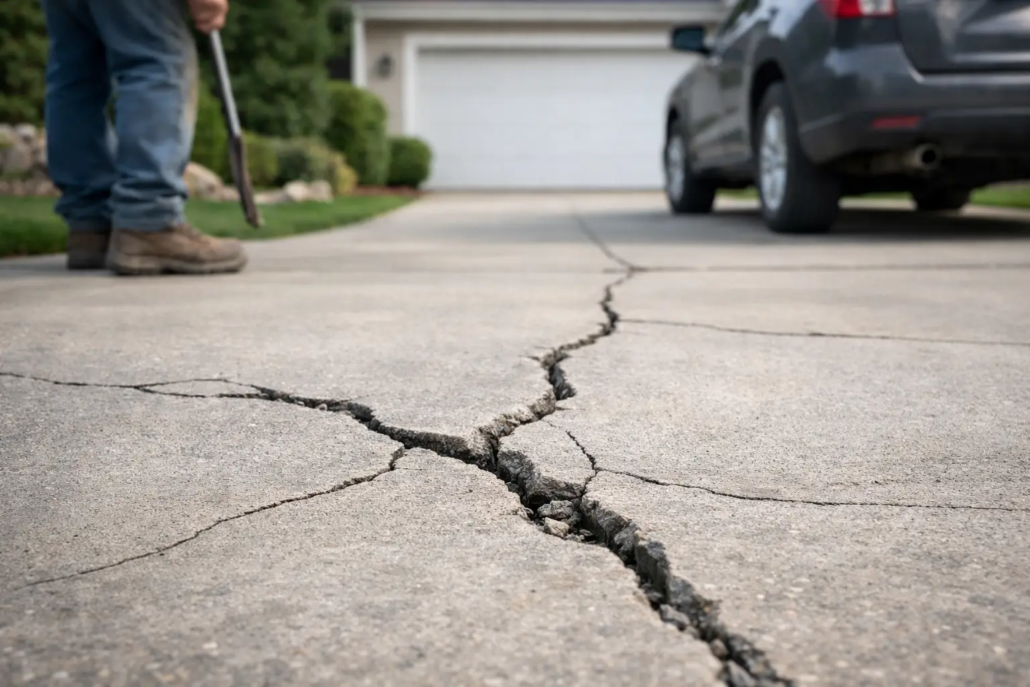
Why Concrete Driveway Cracks Happen
A new driveway should not start splitting for no reason. When property owners ask why concrete driveway cracks, the real answer is usually not one single issue. Cracking happens when design, ground conditions, installation quality and weather all put stress on the slab beyond what it can comfortably handle.
Some cracking is cosmetic and expected over time. Some points to a deeper problem with site preparation, drainage or slab movement. Knowing the difference matters, because the right fix depends on what caused the crack in the first place.
Why concrete driveway cracks in the first place
Concrete is strong in compression, but it is not flexible. As it cures, it shrinks. As temperatures change, it expands and contracts. As vehicles drive over it, the slab carries weight and transfers that load to the base underneath. If any part of that system is weak, movement shows up as cracking.
That is why a driveway is never just about the concrete on top. The finished surface only performs as well as the preparation below it, the reinforcement inside it, the control joints cut into it and the curing process followed after the pour.
In many cases, a crack does not mean the concrete has failed completely. It means the slab found the easiest place to relieve stress. The goal of good concreting is not to promise that concrete will never crack at all. The goal is to control where and how that movement happens so the driveway stays durable, safe and neat.
The most common causes of driveway cracking
Ground movement and poor base preparation
One of the biggest causes of driveway cracking is movement under the slab. If the base is not properly compacted, parts of the driveway can settle at different rates. That creates pressure points, and concrete does not tolerate uneven support well.
This is especially relevant on sites with reactive soils, filled ground or drainage issues. When the soil expands during wet periods and contracts during dry conditions, the slab can shift. Even a well-finished surface can crack if the support underneath is inconsistent.
A proper driveway base needs to be prepared for the specific site conditions, not treated as a one-size-fits-all job. What works on one block may not be enough on another.
Shrinkage during curing
Concrete contains water, and as that water evaporates during curing, the slab shrinks slightly. That shrinkage is normal. If the concrete dries too quickly, the stress can exceed the slab’s capacity and fine cracks may appear.
This is often seen in hot weather, windy conditions or when curing is rushed or neglected. Surface cracking from rapid moisture loss may look minor at first, but it can affect appearance and long-term wear, especially on driveways exposed to regular traffic.
Lack of control joints or poor joint placement
Control joints are there for a reason. They create planned weak points that encourage the concrete to crack in a straight, controlled way rather than randomly across the slab.
If joints are missing, too far apart, too shallow or cut too late, the concrete may crack where it chooses. This is one of the clearest examples of why workmanship matters. A well-placed joint can make the difference between a tidy hairline crack where expected and a visible split through the middle of the driveway.
Heavy loads and slab thickness
Not every driveway is used the same way. A slab designed for standard passenger vehicles may struggle if it regularly carries heavier utes, trailers, boats, caravans or delivery vehicles.
If the concrete thickness, reinforcement or base preparation does not match the expected load, cracking becomes more likely. This is not always obvious at handover. Sometimes the surface looks fine early on, then stress damage appears after repeated use.
That is why intended use should always be part of the planning stage. A driveway needs to be built for real traffic, not just visual appeal.
Water and drainage problems
Water is one of concrete’s biggest long-term challenges. Poor drainage can wash out fines from the base, soften surrounding ground or cause erosion along slab edges. Over time, unsupported sections become vulnerable to cracking under load.
Water also affects the soil itself. On reactive sites, extra moisture can cause expansion, while dry periods can cause shrinkage. That cycle puts repeated movement into the slab and often shows up as cracking near edges, corners or weak spots.
A driveway should always be part of a broader drainage plan. Surface falls, runoff direction and surrounding landscape levels all play a part.
Which cracks are normal and which are a concern?
Not every crack means the driveway needs major repair. Hairline shrinkage cracks can occur even in quality concrete and may be mostly aesthetic. Small, stable cracks that do not widen over time are often manageable.
Wider cracks, cracks with vertical displacement, or cracks that continue to spread are more concerning. If one side of the crack sits higher than the other, that may indicate base failure or ongoing ground movement. Cracks near slab edges and corners can also point to support issues, especially if vehicles are tracking close to the edge.
Pattern matters too. Random cracking across large sections may suggest poor jointing or curing. Repeated cracking in the same area can indicate drainage or subgrade problems that need more than a surface-level repair.
Why installation quality makes such a difference
When people ask why concrete driveway cracks, they are often really asking whether cracking could have been avoided. In many cases, the answer is partly yes.
Concrete has natural limits, and no contractor can honestly promise a driveway will remain completely crack-free forever. What an experienced concreter can do is reduce the risk through sound preparation, the right concrete mix, proper reinforcement, correct joint placement and disciplined curing.
That is where experience shows. The finish on top might be what people notice first, especially with decorative options like exposed aggregate, coloured concrete or stencil concrete, but the unseen work below the surface is what protects long-term performance.
A driveway built with attention to site conditions and usage will usually handle movement and stress far better than one poured quickly with minimal preparation.
How to reduce the risk of cracking
Preventing every crack is unrealistic, but reducing the risk is absolutely possible. It starts with a proper site assessment. Soil conditions, drainage, access, slope and intended vehicle loads should all shape the design.
The base needs to be excavated and compacted correctly. The slab thickness should suit the application. Reinforcement should be placed properly, not treated as an afterthought. Control joints should be planned and installed to suit the layout. Just as importantly, curing should be taken seriously, especially in Queensland conditions where heat and drying winds can accelerate moisture loss.
Ongoing care matters too. Avoid driving or parking heavy vehicles on a driveway that was not designed for them. Keep drainage clear. Try not to let water pond around edges or wash beneath the slab. If a small crack appears, monitor it rather than ignore it for years.
Decorative concrete can crack too
Decorative finishes often raise extra questions because owners are investing in both performance and appearance. The key point is that decorative concrete is still concrete. Exposed aggregate, stamped concrete, polished surfaces and resurfaced finishes all rely on the same structural foundations.
If the slab underneath moves, the finish will show it. In fact, decorative surfaces can make cracking more noticeable simply because the visual standard is higher. That is why the structural side of the job needs just as much attention as the final look.
For homeowners and commercial property owners alike, the best outcome comes from balancing design goals with practical site requirements. A driveway should look sharp, but it also needs to cope with weather, traffic and ground movement over time.
When to get professional advice
If your driveway has a fine, isolated crack that has not changed, it may not need urgent work. If cracks are widening, multiplying, lifting or creating trip hazards, it is worth having the driveway assessed. The same applies if water is pooling, edges are dropping away or sections sound hollow under load.
An experienced concreting team can identify whether the issue is cosmetic, structural or drainage-related, and recommend the most practical next step. In some cases, repair is enough. In others, the underlying cause needs to be addressed to stop the problem returning.
Concrete is a durable, long-lasting material, but it performs best when the installation suits the conditions. If you are planning a new driveway or dealing with cracks in an existing one, the smartest move is to look beyond the surface and focus on how the slab was built, what it is sitting on and how it is being used. That is where the real answer lies.

