
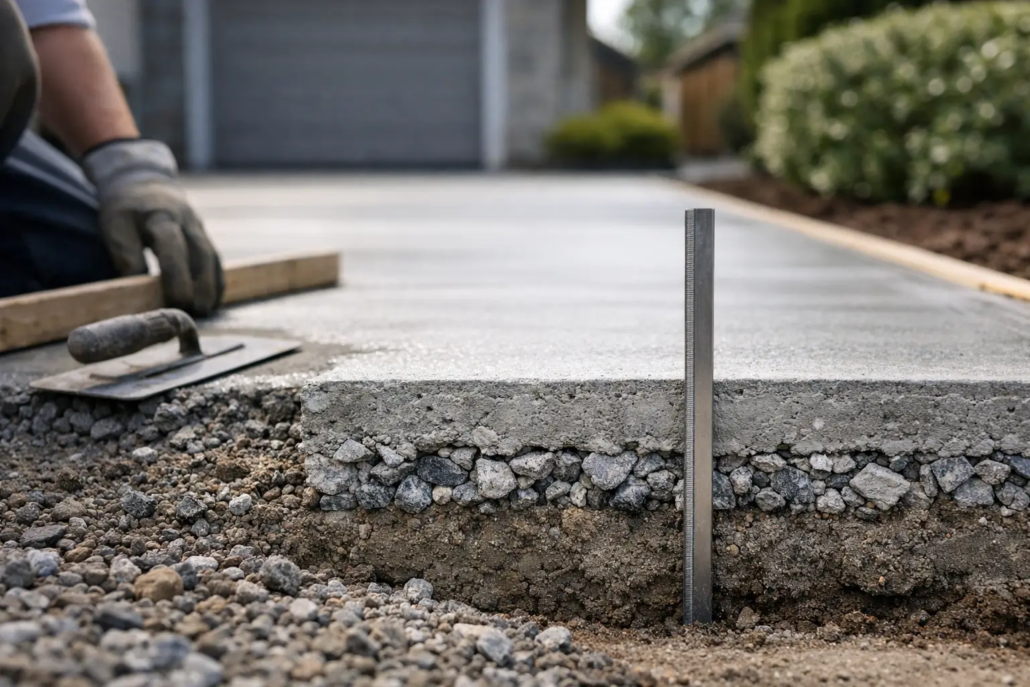
What Is Standard Concrete Driveway Thickness?
A driveway can look perfectly finished on day one and still develop cracks, sinking or broken edges if the slab beneath it is not designed for the load. So, what is standard concrete driveway thickness? For most Australian homes used by passenger vehicles, a 100 mm concrete slab is the usual starting point. But that figure only works when the ground preparation, reinforcement, drainage and intended use are all right.
For a driveway built to last, thickness should never be considered in isolation. A family driveway that carries two cars has very different requirements from an accessway used by utes, caravans, delivery vehicles or machinery. The best result comes from matching the slab construction to the property, not applying a one-size-fits-all solution.
What Is Standard Concrete Driveway Thickness for a Home?
A standard residential concrete driveway is commonly poured at 100 mm thick. This is generally suitable for normal household traffic, including cars, SUVs and light utes, provided it is installed over a properly compacted base.
That 100 mm measurement refers to the concrete itself, not the total depth excavated. Before concrete is poured, the site needs to be prepared with a stable sub-base, typically compacted road base or crushed rock. This layer supports the slab, helps spread vehicle loads and reduces the risk of movement caused by soft or reactive ground.
For many Brisbane, Logan City and Gold Coast properties, careful preparation is particularly valuable. Local sites can range from sandy coastal soils to clay-heavy ground, and each behaves differently after periods of heavy rain or extended dry weather. The correct base depth and compaction method should be determined after assessing the site conditions.
A 100 mm slab is a practical benchmark, not an automatic answer. If the driveway has poor ground beneath it, even a thicker slab may not perform as expected. Equally, a well-prepared base gives a standard-thickness driveway the support it needs for reliable everyday use.
When Should a Concrete Driveway Be Thicker?
A thicker driveway is often the sensible choice where heavier or more frequent loading is expected. In these cases, 125 mm to 150 mm concrete may be specified, with reinforcement and base preparation adjusted to suit.
A 125 mm slab can be appropriate for driveways that regularly carry heavier utes, vans, larger four-wheel drives, boats on trailers or caravans. A 150 mm slab may be needed for access areas used by delivery trucks, waste collection vehicles, machinery, or commercial traffic. It can also be worthwhile where vehicles turn sharply, as turning tyres place extra stress on the concrete surface.
The edges of a driveway deserve special attention. They are more vulnerable to cracking or breaking when a vehicle wheel runs close to the side, especially where there is no supporting kerb, garden edging or adjoining slab. Thickened edges can provide added strength where the driveway meets lawns, garden beds or unrestrained ground.
A driveway extension should also be built to suit the existing driveway and the way the new area will be used. Simply matching the visible finish is not enough. The new section needs suitable depth, reinforcement, joints and sub-base support so it performs as part of the overall surface.
Slopes, crossovers and problem ground
Sloping driveways place different demands on a slab. Water needs to drain away effectively without creating a surface that is difficult to use or prone to washout at the edges. On steep sites, the base may require additional stabilisation, and the concrete design must account for the increased forces created by braking, accelerating and turning vehicles.
Driveway crossovers between private property and the road can also have specific council requirements. Thickness, reinforcement, drainage and levels may need to meet local standards, particularly where a footpath, kerb or stormwater infrastructure is involved. This is one area where proper planning before excavation prevents avoidable rework.
Reactive clay, filled ground and areas with poor drainage need a more considered approach too. These conditions may call for deeper excavation, stronger sub-base construction, additional reinforcement or engineering advice. The goal is not simply to make the concrete thicker. It is to create a stable system from the ground up.
Why the Base Matters as Much as Concrete Thickness
Concrete is strong in compression, but it is not designed to bridge voids beneath the slab. When the ground settles, washes away or moves, the slab loses support. That is when cracking and uneven sections are more likely to appear.
A quality driveway installation starts by removing unsuitable material and bringing the site to the required levels. The sub-base is then placed in layers and mechanically compacted. This creates an even platform for the concrete and helps prevent water from collecting below the driveway.
Good drainage is equally important. Surface water should flow towards appropriate drainage points rather than ponding against the garage, house slab or driveway edges. Water entering the base can soften soil, undermine support and shorten the working life of the surface.
This is why a thin slab on an excellent base can perform better than a thick slab placed over loose, poorly prepared material. Thickness adds capacity, but sound preparation provides the foundation for everything above it.
Reinforcement Helps Control Cracking
Most concrete driveways include reinforcement, commonly reinforcing mesh, to help manage cracking and keep the slab performing as a connected surface. Reinforcement does not guarantee that concrete will never crack. Concrete naturally shrinks as it cures, and movement in the ground can still occur.
Its role is to hold the slab together if minor cracking develops and to improve the driveway’s ability to handle service loads. For reinforcement to work properly, it needs to be positioned within the concrete rather than left sitting on the base. Supports are used to lift it into the correct location before the pour.
The reinforcement type and layout should reflect the slab thickness, traffic loads and site conditions. Heavier-use areas, driveways with difficult ground conditions and commercial accessways may require a more specific reinforcing design. An experienced concreter can identify when a standard mesh layout is suitable and when the project needs engineering input.
Control joints are planned, not optional
Control joints are deliberate lines cut or formed into concrete to encourage shrinkage cracks to occur in controlled locations. Without them, cracking can develop more randomly across the surface.
Joint placement depends on the driveway layout, slab depth and changes in direction. Long, wide sections generally need more careful joint planning than a short straight driveway. Joints should also be considered around garage entries, drain grates, existing structures and driveway extensions.
Well-placed joints are a mark of thoughtful workmanship. They support a cleaner-looking finish while allowing the concrete to respond to natural shrinkage and movement.
Does the Finish Change the Required Thickness?
Decorative finishes such as exposed aggregate, coloured concrete and stencil concrete do not usually change the structural thickness required for the driveway. The slab still needs to be designed around its load, base conditions and reinforcement.
What changes is the finishing process. Exposed aggregate requires precise timing during placement and washing to reveal the selected stone evenly. Coloured concrete needs consistent batching and finishing practices to achieve an even appearance. Stencil and stamped finishes require careful surface preparation and curing so the pattern remains crisp and durable.
A decorative driveway should never compromise the construction beneath it. The surface may be selected for street appeal, but its long-term value still relies on correct excavation, compaction, concrete placement, jointing and curing.
Questions to Settle Before Your Driveway Is Poured
Before finalising a driveway design, consider how the space will actually be used over the next decade. Will it only carry family cars, or will it need room for a caravan, boat trailer, work ute or occasional delivery vehicle? Is it flat, sloping or close to a retaining wall? Does water currently collect around the garage or along the side boundary?
It is also worth considering access during construction. Concrete trucks, pumps and equipment need a safe way to reach the pour area, particularly on narrow blocks or behind existing homes. Planning these details early helps the job run smoothly and protects surrounding landscaping, paths and structures.
For standard residential use, 100 mm is often the right concrete driveway thickness. Where conditions or vehicle loads demand more, increasing the slab thickness is a worthwhile part of building a driveway that remains safe, functional and attractive for years to come. A site-specific assessment gives you the confidence that the finished surface is not just well presented, but properly built for the way you live or work.

